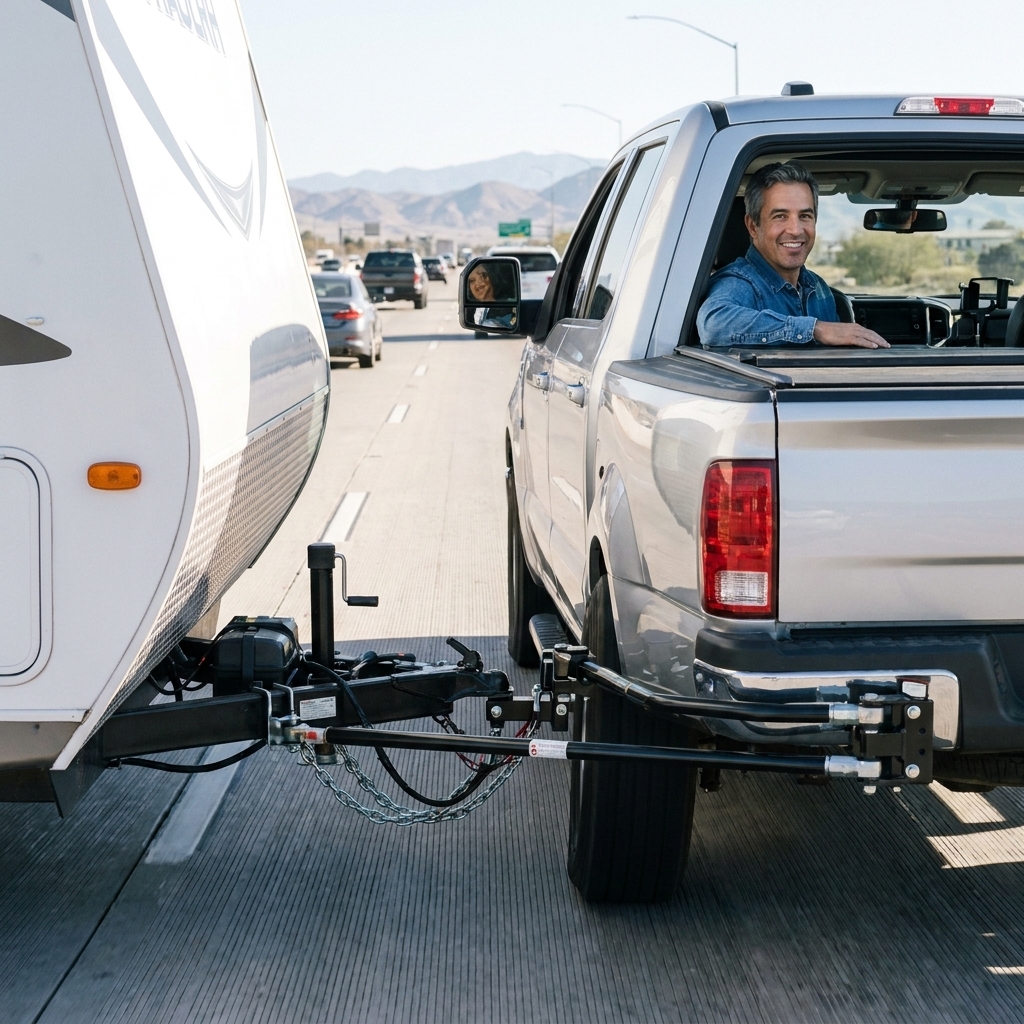
If you have ever felt a trailer start to wag the truck, you have felt tongue weight (or the lack of it) in real time. The good news is you usually do not need fancy parts to fix it. You need to load the trailer with intention.
For most bumper-pull trailers, the sweet spot is about 10 to 15 percent of the trailer’s actual loaded weight sitting on the hitch ball. Think of that as a proven starting range, not a magic law. Always check your trailer, hitch, and tow vehicle manuals, and follow the most conservative guidance you find. Many travel trailers are happiest toward the upper end, while some utility and equipment trailers can tow fine closer to 10 percent depending on design and load.

Let’s walk through what tongue weight really is, how to measure it, and exactly how to move cargo around until the trailer tows calm and predictable.
What tongue weight is
Tongue weight is the downward force the trailer applies to the hitch ball. It is not the same thing as trailer weight. It is the portion of the trailer’s loaded weight carried by your truck.
The reason the 10 to 15% range works is stability. With enough weight on the tongue, the trailer “wants” to track behind the truck instead of pivoting around the axles. With too little tongue weight, small inputs like wind gusts, passing semis, road crown, or a quick steering correction can start a sway cycle that builds instead of settles down.
Quick target math
- Loaded trailer weight 4,000 lb → target tongue weight 400 to 600 lb
- Loaded trailer weight 7,000 lb → target tongue weight 700 to 1,050 lb
- Loaded trailer weight 10,000 lb → target tongue weight 1,000 to 1,500 lb
Notice I said loaded. Dry weights from brochures do not count once you add water, tools, coolers, generators, firewood, or that “one last thing” your family tosses in right before you leave.
The physics in driveway terms
Think of your trailer like a wheelbarrow with two wheels. If you stack everything behind the wheels, the handles get light and the load wants to swing around. If you stack too much forward of the wheels, the handles get brutally heavy.
Your trailer axles are the “wheels” in that analogy. Cargo placed ahead of the axles increases tongue weight. Cargo placed behind the axles reduces tongue weight and is one of the quickest ways to invite sway.
Rule of thumb: Put the heavy stuff low, centered left to right, and slightly forward of the axles. Avoid heavy weight all the way at the back, even if it fits perfectly.

Know the limits
You can hit “perfect” tongue weight and still be overloaded somewhere else. Before you play cargo Tetris, make sure you understand the limits that protect your truck and trailer.
Key ratings to respect
- Trailer GVWR: max the trailer can weigh fully loaded.
- GAWR (trailer axles): max each axle can carry.
- Tire load ratings: often the real bottleneck on utility and travel trailers.
- Hitch rating: your receiver’s max tongue weight and max trailer weight (with and without weight distribution).
- Ball mount and hitch ball ratings: these matter just as much as the receiver.
- Truck payload: everything in the truck plus tongue weight counts against it.
- Rear axle rating: tongue weight plus bed cargo plus passengers can overload the rear axle even when payload looks fine on paper.
If you are towing a travel trailer, remember this: a “600 lb tongue weight” brochure number is usually dry. Once you add propane, battery, food, water, and gear, that tongue weight number can climb fast.
Safety note that is worth repeating: follow the lowest-rated component in the whole chain, including coupler, receiver, ball mount, hitch ball, safety chains, tires, and the tow vehicle’s payload and axle ratings.
How to measure tongue weight
1) A tongue weight scale
A purpose-built tongue scale is the cleanest option for most DIYers. Chock the trailer wheels, keep the trailer level, and measure at the coupler or jack point per the scale instructions.
Pros: quick, repeatable. Cons: you need to buy one, and some max out below heavier trailer tongue weights.
2) A CAT scale
If you want to be thorough, a public truck scale is hard to beat. You can get actual axle weights on the truck, and you can calculate tongue weight by comparing the truck’s total axle weight with and without the trailer coupled.
On a typical CAT scale, you will usually place the front axle on platform 1, the rear axle on platform 2, and the trailer axles on platform 3. Layouts can vary, so follow posted directions.
A practical two-weigh method:
- Weigh 1 (truck only): record steer axle, drive axle, and total.
- Weigh 2 (truck plus trailer coupled): put truck axles and trailer axles on the scale and record all axle weights.
Tongue weight (approx.) = (truck steer + truck drive in Weigh 2) minus (truck steer + truck drive in Weigh 1).
If you use a weight distribution hitch, you will see the tongue load shift between the truck’s front and rear axles, but the tongue weight calculation above still comes from the change in the truck’s combined axle weights.
Pros: shows if you are over on axles. Cons: takes time, costs a few bucks, and you need a scale nearby.
3) The bathroom scale method
You can use a bathroom scale with a lever setup, but it is only appropriate for lighter tongue weights and it is easier to do wrong than right. If you are anywhere near the scale’s max rating, skip this and use a real tongue scale or CAT scale.
Load it step by step
Step 1: Start level
Park on level ground. Chock the wheels. Level the trailer using the tongue jack. If the trailer is nose-high or nose-low, your tongue weight reading and your handling can change.
Step 2: Heavy items low
Heavy items belong on the floor, not on shelves, not stacked high, and not bouncing on the rear bumper rack.
- On a utility trailer hauling equipment, that means positioning the machine so its center of mass is slightly forward of the axle group.
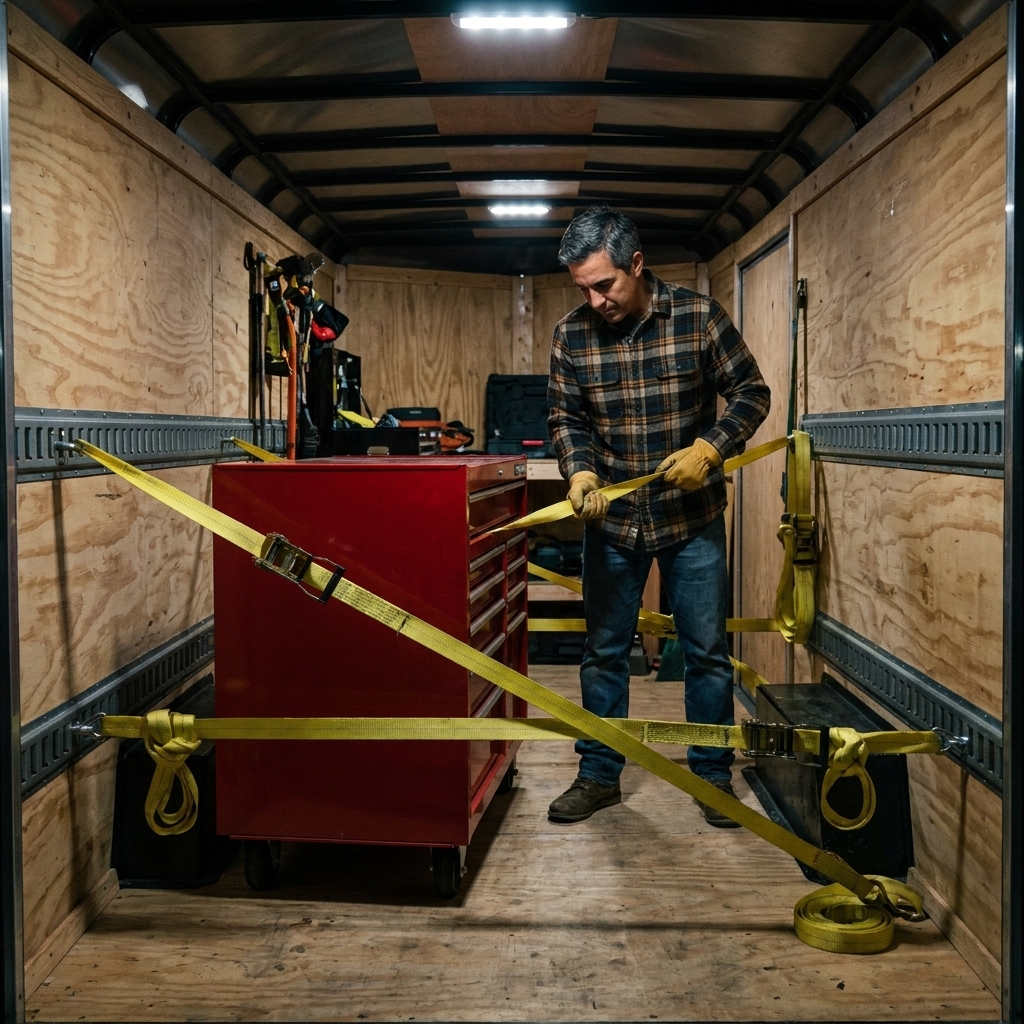
- On an enclosed cargo trailer, that means tool chests, totes, and shop gear low and slightly forward of the axles.
- On a travel trailer, that means being mindful of what you pack in rear storage compartments.
Step 3: Move weight in small steps
If your tongue weight is light, do not panic-load everything into the front V-nose. Move weight forward in small, measurable steps, then re-check. A 150 lb generator moved 2 feet can change tongue weight more than you think.
Step 4: Balance left to right
Tongue weight gets most of the attention, but side-to-side balance matters for tire loading and braking. If all your heavy gear sits on the curb side, you can overload one trailer tire while the other looks fine.
A simple habit: when you add one heavy item to the left, add a similar weight to the right if possible, or at least keep the pile centered.
Step 5: Secure the load
Perfect tongue weight does you no good if the load can slide rearward when you brake.
- Use rated straps and proper anchor points.
- For equipment: strap at four corners, compress suspension a bit, and secure attachments.
- For cargo: use load bars, E-track, or netting so weight cannot migrate.
Step 6: Re-check when fully packed
Check tongue weight after everything is packed including water, fuel cans, coolers, and last minute items. Then confirm your hitch setup and truck stance are still reasonable.
Mistakes that cause sway
- Heavy gear behind the axles: the classic sway starter.
- Rear-mounted cargo racks on travel trailers: they act like a lever arm and can take tongue weight away fast.
- Filling the rear storage because it is convenient: convenience is not stability.
- Uneven side loading: can make the trailer feel twitchy and stress tires.
- Trailer not level: can change handling and braking, and it often means your weight distribution hitch is not set right.
- Trusting dry tongue weight numbers: real camping weight is almost always higher.
Other sway causes
Tongue weight is a big one, but it is not the only variable. If you are fighting sway, also look at the basics:
- Speed: the faster you go, the easier it is for sway to build.
- Trailer tire pressure and condition: underinflated or aging tires can make a trailer feel loose.
- Truck suspension and steering: worn shocks, loose steering components, or soft rear suspension can make things worse.
- Hitch height and trailer attitude: start near level per manufacturer guidance, then fine-tune if needed.
- Trailer brakes: poorly adjusted or weak brakes can let the trailer push the truck.
- Trailer length versus wheelbase: some combinations are simply more sensitive and require extra care.
Signs it is off
I am still going to recommend you measure it, but you can often spot trouble early.
Too little tongue weight
- Trailer sway starts at moderate speeds and gets worse quickly.
- The trailer feels like it is pushing the truck around in crosswinds.
- Small steering inputs feel amplified.
- The trailer looks slightly tail-heavy when parked.
Too much tongue weight
- Truck squats hard in the rear and the front end gets light.
- Steering feels vague, especially in rain or on grooved pavement.
- Headlights point up.
- Rear suspension bottoms out over dips.
- You are running out of payload once passengers and bed cargo are included.
If you see these, slow down and fix the load. Do not assume a sway control device will cover for a tail-heavy trailer. Loading comes first.
Where a WDH fits
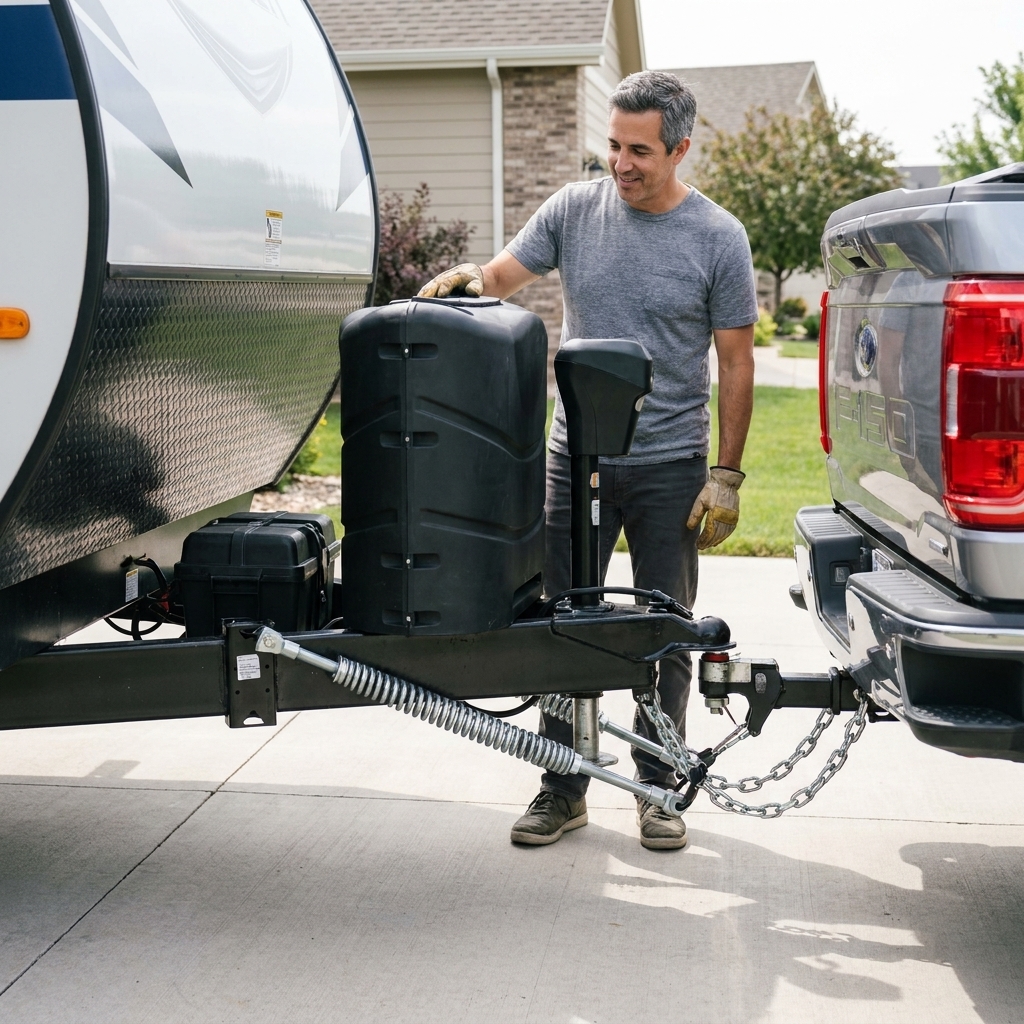
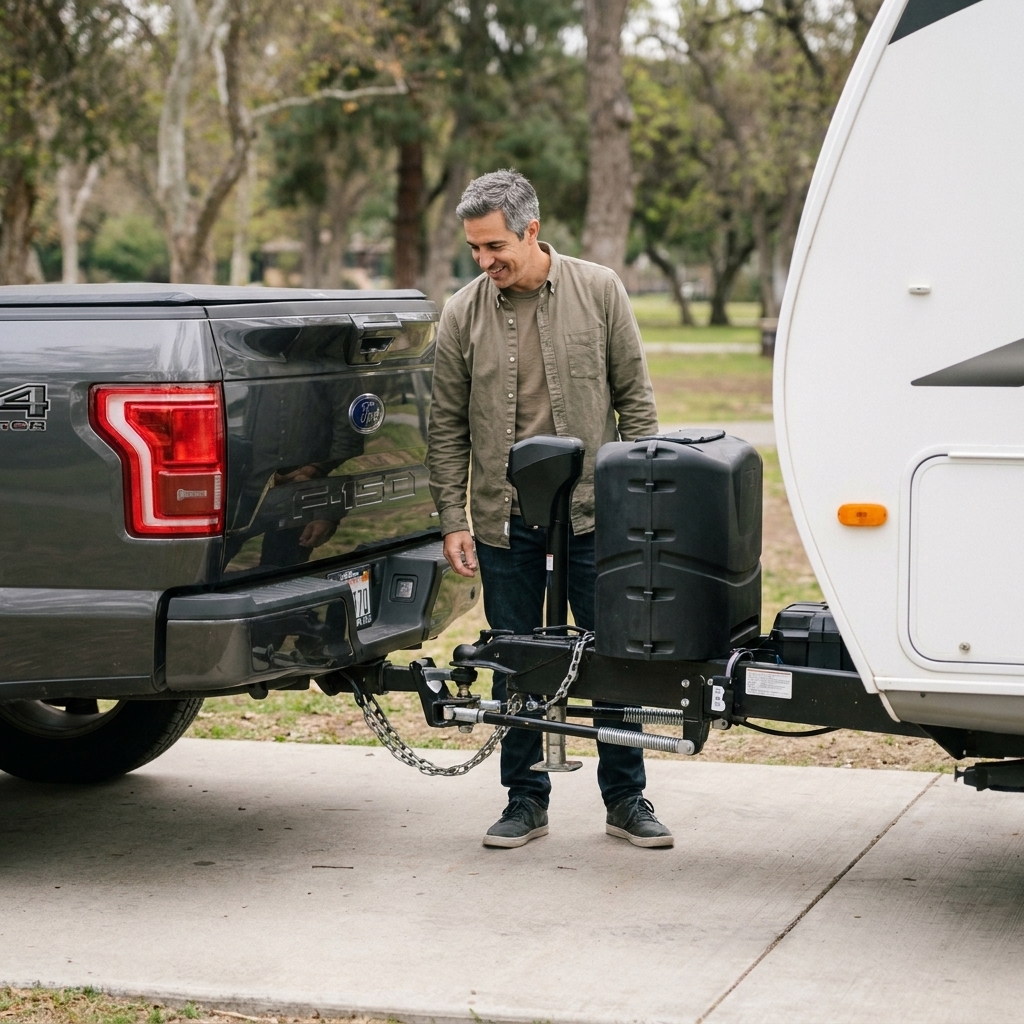
A weight distribution hitch (WDH) does not reduce the trailer’s actual tongue weight at the coupler. What it does is redistribute how that load is carried by the rig, transferring some load back onto the trailer axles and forward onto the truck’s front axle. That helps the truck sit closer to level and improves steering and braking.
Two important points I have learned the hard way in fleet life:
- A WDH is not a band-aid for a tail-heavy trailer. You still need that 10 to 15% tongue weight target (or your trailer manufacturer’s target).
- Set up matters. If the bars are too loose, you gain very little. If they are too tight, you can create a harsh ride and odd handling.
Real-world examples
Example 1: Utility trailer
Say your loaded trailer weight is 6,000 lb. Your tongue weight target is 600 to 900 lb.
If the tractor is loaded too far back, you might measure 450 lb and feel sway starting around 55 mph. Moving the tractor forward a few inches at a time until you measure 700 lb typically transforms the tow. Same trailer, same truck, totally different behavior.
Example 2: Cargo trailer
You load 1,200 lb of tools at the very rear because it is easy to roll in. The trailer feels light on the hitch and squirrely. Relocating the tool chests to just ahead of the axle line, then strapping them tight, often lands you back in the safe tongue weight window.
Example 3: Travel trailer
You toss bikes, a generator, and a cooler in the rear storage area. Tongue weight drops, sway gets worse, and the fix is counterintuitive: move heavy items forward, keep tanks in mind, and measure again.
Quick checklist
- Trailer is set up close to level when hitched, per manufacturer guidance.
- Tongue weight is in the 10 to 15% range for most bumper-pull towing, or whatever your manufacturer specifies.
- Load is centered left to right and heavy items are low.
- Nothing heavy is stored at the extreme rear.
- Cargo is strapped so it cannot slide or roll.
- Tires are inflated to the correct pressure for the load.
- Hitch ball size matches the coupler and the latch is pinned.
- Safety chains crossed, breakaway cable attached correctly, lights checked.
FAQ
Is 10 to 15% always correct?
For most bumper-pull trailers, it is a solid general target. Some trailers and setups tow better near the upper end of that range. The best answer is to start there, then confirm against the trailer and hitch manufacturer guidance and verify with a scale.
Can sway control replace proper loading?
Sway control can help, but it should not be used to mask a tail-heavy load. Get tongue weight right first. Then add sway control if your trailer and conditions call for it.
Why did my tongue weight change when I filled my tanks?
Because you changed where the weight sits relative to the axles. Fresh water tanks, gray tanks, fuel stations, and battery locations vary by trailer. Depending on where that weight sits, filling tanks can shift tongue weight significantly, sometimes 100 lb or more.
My truck squats. Is that automatically too much tongue weight?
Not automatically. Some trucks have soft rear springs, and some loads are simply heavy. Measure tongue weight, confirm you are within hitch ratings and truck payload, and consider a properly set weight distribution hitch if the trailer is large enough to warrant it.
What about gooseneck and fifth-wheel pin weight?
Different animal. Many fifth-wheel and gooseneck setups commonly land around 15 to 25% pin weight, but the correct target depends on the trailer design and manufacturer specs. Use a scale and follow the ratings on the truck and hitch.
Bottom line
The calmest towing setups are rarely the fanciest. They are the ones where the driver took 20 minutes to load with purpose and verify tongue weight. Aim for about 10 to 15% on most bumper-pull trailers, keep heavy cargo low and slightly forward of the axles, secure everything so it cannot move, and your trailer will follow like it is supposed to.
If you want a simple next step, pick one method to measure tongue weight and do it once with your typical load. After that, you will start to recognize what “right” looks like, and you will spend a lot less time white-knuckling the steering wheel.